Quick ViewAt a Glance
Driving on worn, cracked, or damaged tyres in Malawi is a serious road safety hazard that puts you and your passengers at risk of blowouts, loss of control, and increased stopping distances. Many drivers in Lilongwe and Blantyre continue to drive on tyres long past their safe service life, either unaware of the warning signs or unable to find a reliable, affordable tyre shop. Knowing when to replace your tyres and choosing the correct size, tread pattern, and load rating for Malawi’s unique road conditions is essential. Malawi’s roads feature a combination of well-paved highways and unpaved, pothole-riddled secondary routes that demand tyres with strong sidewalls and durable tread compounds. To ensure maximum safety and tyre longevity, have your tyres professionally inspected and fitted at a certified tyre centre like Carbon365 in Lilongwe or Blantyre.
Every driver in Malawi depends on their tyres for safe daily commutes—whether navigating the roundabouts and speed humps of Lilongwe’s Area 47, crossing the busy Chipembere Highway in Blantyre, or making the long inter-city journey along the M1 highway between the two cities. Yet tyres are one of the most neglected maintenance items on vehicles across Malawi.
The consequences of ignoring tyre wear are severe. A tyre with insufficient tread depth cannot evacuate water effectively during the rainy season, increasing the risk of hydroplaning. A tyre with sidewall damage from pothole impacts can fail catastrophically at highway speeds. And a tyre that has aged beyond its manufacturer’s recommended lifespan (typically 5 years) becomes structurally brittle, regardless of how much tread remains.
Understanding when your tyres need replacing, selecting the right tyre for Malawi’s road terrain, and trusting a professional tyre fitting near me Lilongwe service will protect both your safety and your wallet in the long term.
How to Know When Your Tyres Need Replacing
Many drivers wait until a tyre goes completely flat before considering a replacement. By that point, the tyre has likely been unsafe for thousands of kilometres. Here are the critical warning signs every Malawian driver should know:
1. Tread Depth Below the Legal Minimum
The tread grooves on your tyres are designed to channel water, mud, and loose gravel away from the contact patch. As the tread wears down, the tyre’s grip deteriorates—especially on wet roads during the rainy season between November and April.
- The Coin Test: Insert a 10 Kwacha coin into the main tread groove. If you can see the top of the coin’s design clearly, your tread is dangerously low and needs immediate replacement.
- Tread Wear Indicators (TWI): Every genuine tyre has small rubber bars moulded into the base of the tread grooves. When the tread surface wears down to the same level as these bars, the tyre has reached its absolute minimum safe limit.
2. Sidewall Cracks, Cuts, or Bulges
Inspect the smooth rubber area between the tread edge and the wheel rim. If you see fine cracks running along the sidewall, the rubber compound has degraded due to heat, UV exposure, and age. Deep cuts or visible fabric cords indicate structural failure. A sidewall bulge—a raised bump or bubble—means the internal reinforcing cords have snapped, usually from hitting a pothole. A tyre with a sidewall bulge must never be driven on; it can explode without warning.
3. Age Beyond 5 Years
Even if a tyre appears to have deep tread, it has a limited chemical lifespan. Rubber hardens and loses its elasticity over time due to ozone and oxidation. Check the DOT date code on the sidewall—the last four digits indicate the week and year of manufacture (e.g., 2423 means week 24 of 2023). If your tyre is older than 5 years, it is time for a replacement, regardless of visible tread depth.
4. Vibration, Pulling, or Uneven Wear
If your steering wheel vibrates at speed, your car pulls to one side, or you notice that one edge of the tyre is wearing faster than the other, these symptoms indicate a tyre or alignment problem. Uneven wear often means a tyre cannot be rotated back to useful service and must be replaced, along with a wheel alignment check.
Choosing the Right Tyres for Malawi’s Road Terrain
Malawi’s road network presents a wide range of surfaces. The M1 highway between Lilongwe and Blantyre is well-paved, while many urban side streets and rural feeder roads are gravel, dirt, or badly potholed. Selecting the right tyre type for your driving habits is essential.
Highway Touring Tyres (HT)
If you primarily drive on paved urban roads in Lilongwe or Blantyre, a highway touring tyre offers the best combination of comfort, fuel efficiency, and road noise reduction. These tyres feature a smooth, continuous tread rib pattern optimized for grip on tarmac.
- Best for: Daily commuters, sedans, and small SUVs.
- Recommended brands: Dunlop SP Sport, Bridgestone Turanza, Michelin Energy.
All-Terrain Tyres (AT)
For drivers who regularly travel between cities, visit rural areas, or traverse unpaved roads, an all-terrain tyre provides a balanced mix of on-road comfort and off-road traction. The tread blocks are wider and more aggressive than highway tyres, with reinforced sidewalls to resist damage from sharp stones and potholes.
- Best for: SUVs, pickups, and drivers who travel between Lilongwe and Blantyre frequently.
- Recommended brands: Dunlop Grandtrek AT3, Bridgestone Dueler AT, Michelin LTX AT2.
Mud-Terrain Tyres (MT)
If you frequently drive through heavy mud, deep gravel, or construction sites, a mud-terrain tyre offers maximum off-road grip. However, these tyres are noisy on tarmac and wear faster on paved roads.
- Best for: Farm vehicles, construction-site vehicles, and off-road enthusiasts.
Professional Tyre Fitting at Carbon365 Branches
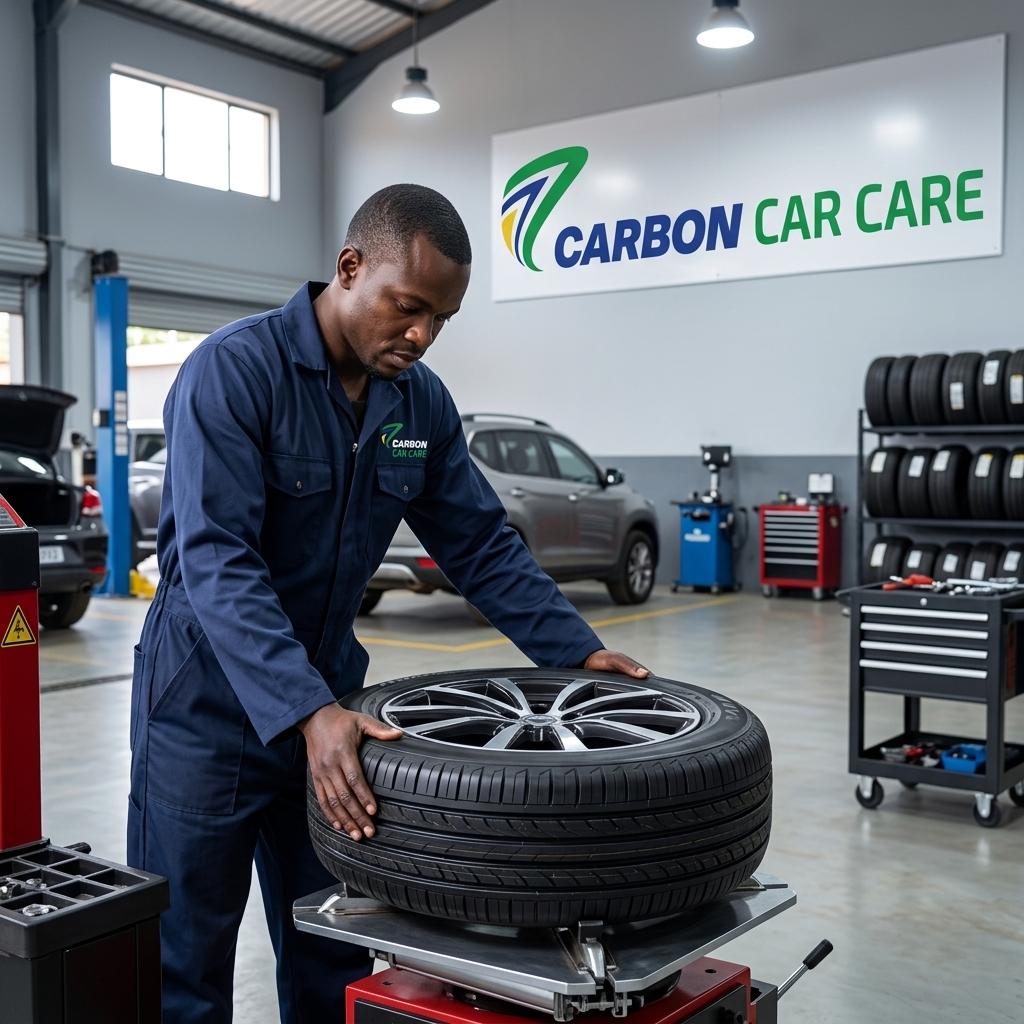
Correct tyre fitting is just as important as selecting the right tyre. An improperly mounted tyre can lead to air leaks, vibrations, and dangerous bead failures at high speed. At Carbon365’s workshops in Lilongwe and Blantyre, every tyre installation follows a professional, multi-step process:
- Wheel Removal and Inspection: Each wheel is removed and inspected for rim damage, corrosion, or bent lips that could compromise the tyre seal.
- Old Tyre Demounting: The worn tyre is carefully demounted using advanced machines that protect the rim from scratches and dents. The valve stem is inspected and replaced if worn.
- New Tyre Mounting: The replacement tyre is lubricated and mounted onto the rim using precision fitting equipment. The tyre bead is carefully seated against the rim flange to ensure an airtight seal.
- Computerized Wheel Balancing: After mounting, the wheel-and-tyre assembly is placed on a computerized spin-balancer. Small lead or adhesive weights are placed on the rim to eliminate vibrations and ensure smooth, shake-free driving at all speeds.
- Torque-Controlled Reinstallation: The balanced wheel is reinstalled onto the vehicle using a calibrated torque wrench. Each wheel nut is tightened to the manufacturer’s specified torque to prevent loosening.
- Tyre Pressure Setting: The final step is inflating the tyre to the correct pressure for your vehicle’s weight and driving conditions, as specified by the vehicle manufacturer’s door placard.
Schedule Tyre Fitting in Lilongwe or Blantyre
Don’t wait for a blowout on the M1 highway or a flat tyre in Lilongwe traffic to replace your worn tyres. At Carbon365 Malawi, we stock a wide selection of premium, genuine tyres from leading global manufacturers—all backed by manufacturer warranties and professional fitting by our expert technicians.
Drive safely, extend your vehicle’s life, and protect your passengers. Contact Carbon365 today to check our current tyre inventory and schedule your professional fitting!
Frequently Asked Questions (FAQ)
1. How much does a tyre replacement cost in Malawi?
Tyre prices in Malawi vary depending on the brand, size, and type. A standard passenger car tyre (e.g., 195/65R15) from a reputable brand like Dunlop or Bridgestone typically costs between MWK 120,000 and MWK 250,000. SUV and 4×4 tyres, which are larger and require reinforced construction, can range from MWK 200,000 to MWK 450,000. At Carbon365, we offer competitive pricing with free professional fitting included.
2. Should I replace all four tyres at once, or can I replace just one?
Ideally, tyres should be replaced in pairs (both front or both rear) to maintain balanced handling and braking. If only one tyre is damaged, the replacement tyre should match the remaining tyre on the same axle in brand, size, tread pattern, and tread depth. Mismatched tyres can cause unpredictable handling, especially on wet roads.
3. How often should I rotate my tyres in Malawi?
We recommend rotating your tyres every 8,000 to 10,000 kilometres, or at every second service interval. Tyre rotation moves each tyre to a different wheel position, ensuring that all four tyres wear evenly. This extends overall tyre life and maintains consistent grip across all four wheels.
4. Can I use tyres from different brands on my car?
While it is technically possible, we strongly advise against mixing tyre brands across the same axle. Different brands have different rubber compounds, tread designs, and grip characteristics. Mixing brands on the same axle can cause uneven braking force and unpredictable handling, especially in emergency manoeuvres or wet conditions.