Quick ViewAt a Glance
In the sweltering heat of Lagos, a malfunctioning car air conditioning system is more than an inconvenience—it is a safety and health hazard that affects driver concentration, causes dehydration, and makes long commutes in traffic unbearable. The most common complaint from Lagos drivers is that their car AC is blowing warm or hot air instead of cold. This problem is typically caused by one or more of three issues: low refrigerant levels due to a leak in the AC system, a failing or seized AC compressor, or a clogged cabin air filter that restricts airflow. Many drivers attempt to fix the problem by simply topping up refrigerant gas at roadside mechanics, but without proper leak detection and diagnostic testing, this temporary fix fails within days or weeks. For a lasting solution, professional AC diagnostics using electronic leak detectors and manifold gauge analysis at a certified workshop like Carbon365 Lagos is essential.
Lagos is one of the hottest and most traffic-congested cities in West Africa. With daytime temperatures regularly climbing above 33°C—and in-car cabin temperatures exceeding 50°C when parked in direct sunlight—a properly functioning car air conditioning system is not a luxury; it is a daily survival tool.
Every driver in Lagos has experienced it: you start your car in the morning, switch on the AC, and instead of a blast of cool air, you are met with warm, stale air blowing from the vents. You crank the temperature dial to its coldest setting, increase the fan speed, and still nothing changes. The cabin stays hot. The steering wheel burns your hands. The leather seats are uncomfortable. Your concentration drops in traffic, and the commute from the Mainland to Island becomes miserable.
This scenario is alarmingly common across Lagos, Abuja, and Port Harcourt. Yet many drivers either tolerate the problem or take their car to roadside mechanics who provide band-aid fixes that fail within weeks. Understanding the root causes of car AC repair Lagos problems and knowing when to seek professional diagnostics will save you time, money, and discomfort.
In this comprehensive guide, we will explain the most common reasons why your car AC blowing hot air Lagos happens, break down the key components that fail, and show why professional AC diagnostics at Carbon365 Lagos is the only reliable path to a permanently cool cabin.
Why is My Car AC Blowing Warm Air?
A car’s air conditioning system is a closed-loop refrigeration cycle. It compresses a refrigerant gas (typically R134a or the newer R1234yf) into a high-pressure liquid, passes it through a condenser to dissipate heat, then expands it through an evaporator coil inside the dashboard to absorb heat from the cabin air. When any component in this cycle fails, the system loses its ability to cool.
Here are the most common causes of AC failure in Lagos vehicles:
1. Low Refrigerant (AC Gas) Due to a Leak
The number one reason car ACs stop cooling in Nigeria is a refrigerant leak. The AC system is sealed, and under normal conditions, refrigerant levels should remain stable for years. However, the extreme heat and vibration from Lagos roads accelerate the degradation of rubber O-ring seals, hose joints, and the AC condenser (which sits directly behind the front bumper and is exposed to road debris).
When refrigerant leaks out gradually, the system’s cooling capacity drops proportionally. At first, the AC may blow slightly less cold air. As more gas escapes, the air becomes lukewarm, and eventually, the system blows warm air entirely.
Why a simple top-up is not enough: Many roadside mechanics offer to “top up your AC gas” for a few thousand Naira. While this temporarily restores cooling, it does not fix the underlying leak. The new gas escapes through the same leak point, and within days or weeks, the AC is warm again. Worse, running the compressor with chronically low refrigerant causes it to overheat and seize—turning a ₦15,000 leak repair into a ₦150,000+ compressor replacement.
2. Failing or Seized AC Compressor
The AC compressor is the heart of the system. It is a mechanical pump driven by a belt connected to the engine. The compressor pressurizes the refrigerant gas and circulates it through the system. In Lagos traffic, the compressor runs for hours on end under extreme heat, placing enormous stress on its internal bearings, valve plate, and electromagnetic clutch.
Signs of compressor failure include:
- Loud clicking or grinding noise when the AC is switched on.
- AC clutch engaging and disengaging rapidly (cycling on and off every few seconds).
- No cold air at all, even after a fresh gas recharge.
- Visible oil stains around the compressor body or hose connections (indicating a shaft seal leak).
A seized compressor also contaminates the entire AC system with metal debris from its damaged internal bearings. This debris travels through the AC lines and clogs the condenser, expansion valve, and receiver drier. In such cases, a complete system flush and multiple component replacements are required.
3. Clogged or Dirty Cabin Air Filter
Many Nigerian drivers are unaware that their car has a cabin air filter—a fibrous filter located behind the glove box that screens dust, pollen, and pollution from the air entering the cabin through the AC vents. In Lagos, where traffic pollution and fine dust levels are extremely high, this filter clogs rapidly.
A clogged cabin filter restricts the volume of air flowing across the evaporator coil. Even if the evaporator is ice-cold, reduced airflow means the cabin takes much longer to cool down. In severe cases, the restricted airflow causes the evaporator to freeze over, blocking cooling entirely.
Recommendation: Replace your cabin air filter every 10,000 km or every 6 months in Lagos conditions. At Carbon365, we include a cabin filter inspection in every AC service.
4. Blocked or Leaking AC Condenser
The AC condenser is a thin, radiator-like component mounted directly in front of the engine radiator, behind the front bumper grille. Its job is to dissipate the heat absorbed from the cabin into the outside air. Because of its exposed position, the condenser is vulnerable to:
- Road debris damage: Small stones, gravel, and even insects can puncture the thin aluminium tubes of the condenser, causing refrigerant leaks.
- Blocked airflow: Accumulated dust, insects, and plastic bags trapped between the condenser and radiator restrict airflow, reducing the condenser’s ability to shed heat.
The Importance of Professional AC Diagnostics
A functioning AC system depends on the correct balance of refrigerant pressure, airflow, and component integrity. Diagnosing AC problems by guesswork—or simply adding gas without testing—wastes money and can cause further damage.
What Professional AC Diagnostics Includes at Carbon365
At Carbon365 Lagos, our certified AC technicians perform a comprehensive diagnostic process:
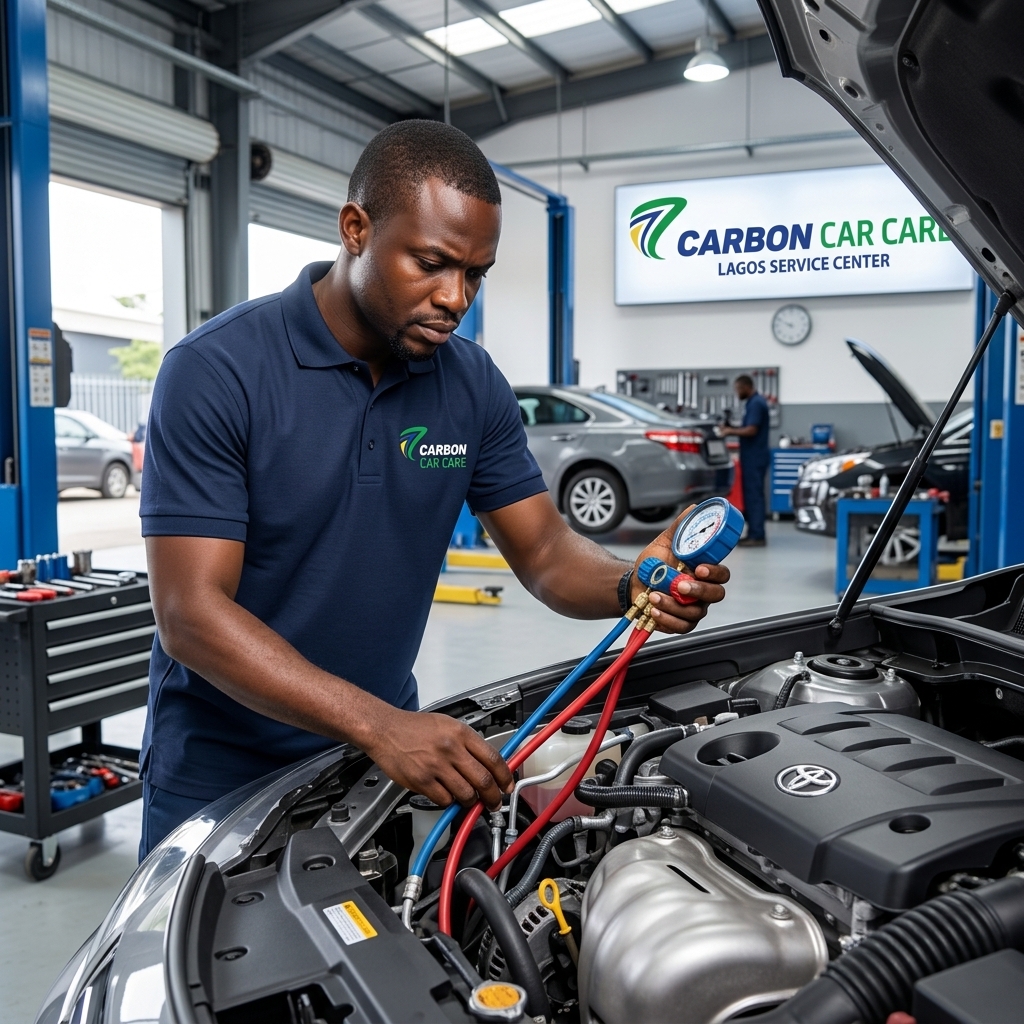
- Manifold Gauge Pressure Test: A set of high-pressure and low-pressure gauges are connected to the AC system’s service ports. By reading the static and running pressures, the technician can determine whether the system is undercharged (leak), overcharged (previous bad recharge), or has a restriction (blocked expansion valve or filter drier).
- Electronic Leak Detection: A high-sensitivity electronic refrigerant sniffer is passed over every joint, hose, seal, and component in the system. This device detects even microscopic leaks that are invisible to the naked eye.
- UV Dye Leak Trace: For intermittent leaks that are difficult to locate, a UV fluorescent dye is injected into the system. After running the AC for a period, a UV lamp is used to illuminate the exact point where refrigerant is escaping.
- Compressor Clutch and Electrical Test: The technician tests the electromagnetic clutch engagement, compressor relay, pressure switches, and wiring harness to ensure the compressor is receiving correct electrical signals.
- Cabin Temperature and Vent Output Test: Using a digital thermometer, the air temperature at the dashboard vents is measured to verify the system is achieving the target cooling performance (typically 3–8°C at the centre vent with the AC on full cold and recirculation mode).
Common AC Repairs and Their Cost Range in Nigeria
Understanding the typical repair costs helps you budget and avoid being overcharged by unqualified mechanics:
Book a Car AC Check at Carbon365 Lagos
Stop suffering through Lagos heat with a broken AC. Stop wasting money on roadside gas top-ups that fail within weeks. At Carbon365 Lagos, our certified AC specialists use professional-grade diagnostic tools—including electronic leak detectors, manifold gauges, and UV dye tracing—to identify and permanently fix the root cause of your AC problems.
Whether it is a simple gas recharge, a cabin filter replacement, or a full compressor overhaul, Carbon365 delivers lasting results backed by a service warranty.
Beat the Lagos heat. Book your AC diagnostic today!
Frequently Asked Questions (FAQ)
1. How often should I service my car AC in Lagos?
We recommend a full AC system service—including a pressure check, leak inspection, cabin filter replacement, and condenser cleaning—every 12 months or every 15,000 km. In Lagos, where the AC runs for extended hours daily in heavy traffic, annual servicing prevents small issues from becoming expensive failures.
2. Why does my car AC smell bad when I first turn it on?
A musty or mouldy smell from the AC vents is caused by bacteria, mould, and fungal growth on the evaporator coil and inside the blower housing. In Lagos’s humid climate, moisture from the AC condensation process creates a breeding ground for these organisms. An AC antibacterial treatment and evaporator foam cleaning eliminates the smell and improves air quality.
3. Is it bad to run the car AC in heavy Lagos traffic?
No, it is safe to run your AC in traffic. However, prolonged idling puts extra load on the engine and compressor because the condenser receives less airflow at low speeds. To reduce strain, use the recirculation mode (which cools already-cooled cabin air rather than pulling in hot outside air) and avoid setting the temperature to its absolute coldest setting continuously.
4. Can I use my car AC while the engine is warming up?
Modern fuel-injected vehicles can handle AC operation almost immediately after starting. However, for optimal compressor longevity, we recommend allowing the engine to idle for 30 to 60 seconds before engaging the AC. This allows oil to circulate through the engine and compressor before placing them under full load.