Quick ViewAt a Glance
Understanding the difference between wheel alignment and wheel balancing is one of the most critical aspects of car maintenance for Lagos drivers. While both services are essential for smooth handling and extending tyre life, they address different mechanical issues. Wheel alignment is the adjustment of your car’s suspension system to ensure the tyres contact the road at the correct angle, preventing your vehicle from pulling to one side and stopping uneven tyre wear. On the other hand, wheel balancing corrects weight distribution imbalances in the tyre and wheel assembly, preventing high-speed steering wheel vibrations and cabin shaking. On Lagos roads, pothole impacts and rough terrains frequently knock these systems out of specification. To maintain vehicle safety and avoid premature tyre failure, you should schedule both a wheel alignment and balancing check every 10,000 km, or immediately after experiencing steering wheel vibration or a hard suspension impact.
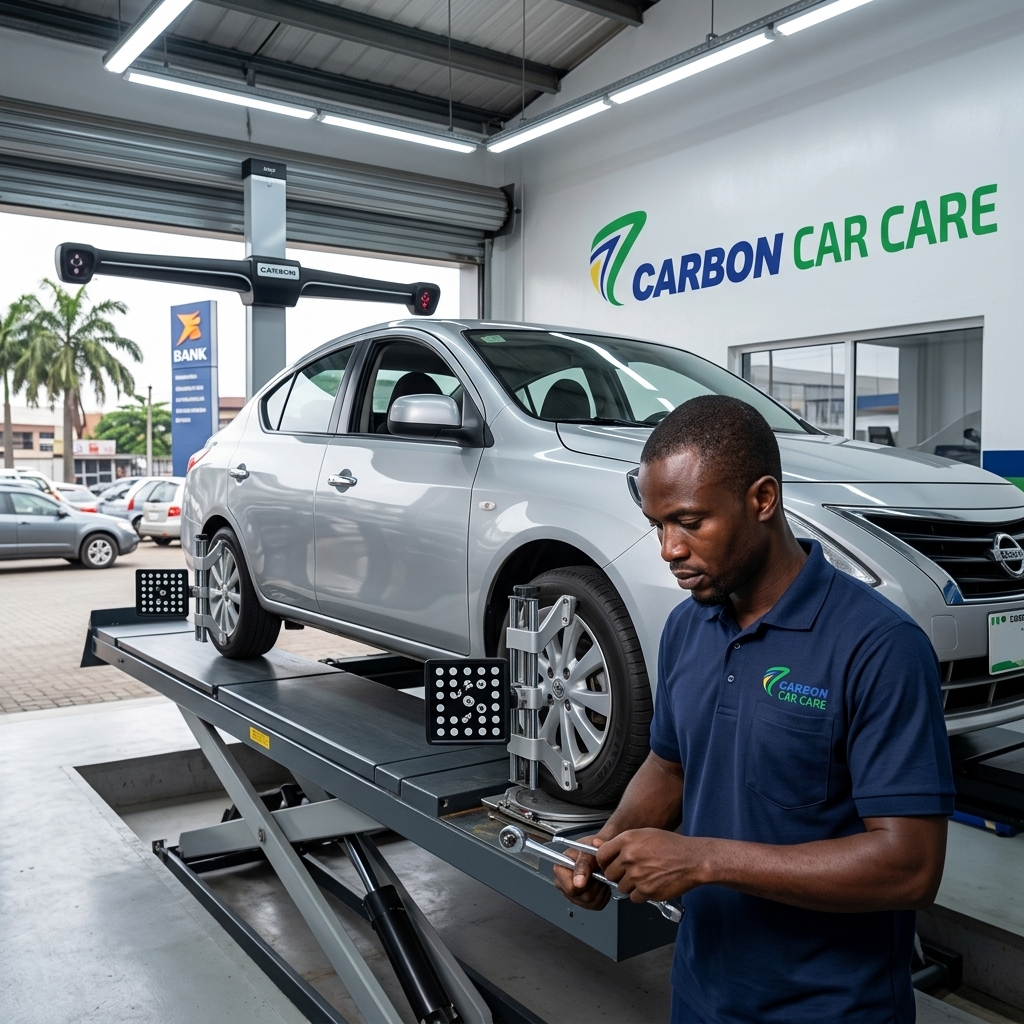
Navigating the daily commute in Lagos—whether you are crawling through stop-and-go traffic on the Third Mainland Bridge, driving along the Lekki-Epe Expressway, or traveling on the rough secondary roads of Ikeja and Surulere—places constant stress on your vehicle’s steering, wheels, and suspension systems. Potholes, high-altitude speed bumps, rough drainage transitions, and uneven road shoulders are daily hazards that Nigerian drivers must deal with.
Unfortunately, many vehicle owners confuse wheel alignment and wheel balancing, often assuming they are the same service or only scheduling them when a tyre is completely ruined. In reality, driving a car with misaligned suspension or unbalanced wheels is one of the quickest ways to waste money on tyres and compromise road safety.
If you are looking to protect your vehicle investment and reduce operating costs, understanding the importance of professional wheel alignment and balancing Lagos is essential. In this comprehensive guide, we will break down what both services actually do, detail their differences, highlight the critical warning signs, compare the real wheel alignment cost Lagos, and help you understand when to do wheel alignment to keep your vehicle running smoothly.
What Is Wheel Alignment? (With Diagram)
Wheel alignment (sometimes called tracking) is not an adjustment of the tyres themselves, but rather the adjustment of your vehicle’s steering and suspension components. The suspension is the system that connects the vehicle to its wheels. Properly aligning this system ensures that your tyres contact the road flat and roll parallel to one another.
When technicians perform a wheel alignment on a 3D laser wheel alignment Lagos system, they measure and adjust three key angles:
- Toe (In or Out): This is the direction your tyres are pointing relative to the vehicle’s centerline when viewed from directly above. If the tyres point inward toward each other, it is called “toe-in.” If they point outward away from each other, it is “toe-out.” Incorrect toe drags the tyres sideways, causing rapid “feathering” wear on the tread.
- Camber (Positive or Negative): This is the vertical tilt of the tyre when viewed from the front of the vehicle. If the top of the tyre tilts inward toward the engine, it is “negative camber.” If it tilts outward, it is “positive camber.” Misaligned camber causes severe, uneven tyre wear on the inner or outer edge of the tread.
- Caster (Positive or Negative): Caster is the angle of the steering axis when viewed from the side of the vehicle. It determines your steering stability, cornering control, and how easily the steering wheel returns to the center after a turn. Incorrect caster does not cause major tyre wear but makes the steering feel heavy or unstable at highway speeds.
- Thrust Angle: This relates to how the rear wheels track behind the front wheels. If the rear axle is crooked, the car will “crab-walk” down the road, putting immense stress on steering links.
Proper alignment ensures that the tyre’s tread contact patch is perfectly flat against the pavement, reducing rolling resistance and maximizing vehicle control.
What Is Wheel Balancing?
Unlike wheel alignment, wheel balancing (or tyre balancing) addresses the weight distribution around the tyre and wheel assembly. Tyres and wheels are never perfectly uniform in weight. During manufacturing, slight variations in rubber thickness and steel belt placement mean one side of the tyre is always slightly heavier than the other.
As the wheel spins at high speeds on Lagos highways, even a tiny weight discrepancy (as small as 10 grams) can generate massive centrifugal forces. This imbalance causes the tyre to hop or wobble as it rotates, creating distinct steering and cabin vibrations.
The Wheel Balancing Process
To correct this imbalance, technicians place the tyre and wheel assembly on a computerized wheel balancing machine.
1. The machine spins the wheel to detect exactly where the heavy spots are.
2. The computer guides the technician to attach small, lead-free adhesive weights to the inner or outer lip of the wheel rim.
3. These weights counterbalance the heavy spots, ensuring the wheel assembly spins with uniform weight distribution.
Unbalanced wheels don’t just cause discomfort; they cause a specific type of tyre wear known as “cupping” or “scalloping,” where dips or wavy patterns appear around the tread. They also place constant, pulsating stress on wheel bearings, shock absorbers, and steering linkages, causing these parts to wear out prematurely.
Key Differences: Alignment vs. Balancing
To help you remember how to care for your car, let’s look at a head-to-head comparison of these two crucial services:
Signs You Need Wheel Alignment in Lagos
Because Lagos roads are filled with potholes and speed bumps, your wheel alignment can be knocked out of spec easily. Tie rods, ball joints, and control arms are metal components that can shift or bend under impact.
Keep an eye out for these five critical warning signs that show it is time to schedule a professional alignment check:
1. The Steering Wheel Pulls or Drifts
If you relax your grip on the steering wheel on a flat road and the car immediately drifts or pulls to the left or right, your alignment is out of spec. This forces you to constantly fight the wheel to maintain a straight line, which is tiring and dangerous.
2. Off-Center Steering Wheel
When you are driving straight down the road, your steering wheel should be perfectly centered. If the logo in the middle of the wheel is crooked or tilted to one side while your wheels are rolling straight, your steering geometry is misaligned.
3. Rapid and Uneven Tyre Shoulder Wear
Check the tread on your front tyres. If the tread on the inner or outer edge is wearing smooth while the center is still deep, you have a camber issue. If the tread feels rough or sharp when you slide your hand across it, you have a toe issue.
4. Squealing Tyres on Gentle Turns
If your alignment is off, the tyres are constantly scrubbing against the road surface at opposing angles. This friction causes tyres to squeal or chirp, even when you are taking gentle turns at low speeds.
5. Heavy or Loose Steering
A caster misalignment can cause the steering to feel sluggish, unusually heavy, or “loose,” where the car feels unresponsive when you turn the wheel.
When to Do Wheel Alignment and Balancing
As a general rule of thumb, you should check your wheel alignment and balancing every 10,000 km or every 6 months. However, driving in Lagos requires a more proactive approach.
You should schedule an immediate check if you experience:
- A hard impact with a deep pothole, open drainage grate, or high curb.
- High-speed steering wheel vibrations (usually felt between 80 km/h and 110 km/h).
- Any uneven tread wear on the edges of your tyres.
- A vehicle pull to one side or a crooked steering wheel.
- After replacing any suspension or steering components (shocks, ball joints, tie rods).
Maintaining proper alignment and balancing is one of the most cost-effective forms of preventative maintenance you can perform. If your alignment is off, a set of brand new premium tyres can wear down to the steel cords in less than 5,000 km. Spending a reasonable wheel alignment cost Lagos protects your tyre investment and improves your fuel economy by up to 10% by reducing tyre rolling resistance.
Book 3D Laser Alignment in Lagos
Don’t wait for steering vibrations or uneven wear to compromise your road safety and waste your tyres. At Carbon365 Lagos, we utilize state-of-the-art digital 3D laser alignment and computerized balancing systems that capture precision measurements of your vehicle’s steering angles, comparing them directly against factory-specified database parameters for your exact vehicle model.
Protect your vehicle, extend tyre life, and enjoy a smooth, vibration-free drive. Contact the expert team at Carbon365 to schedule a professional wheel check today!
🙋 Frequently Asked Questions (FAQ)
1. Can misaligned wheels affect my car’s fuel consumption?
Yes, absolutely. When your wheels are out of alignment, the tyres do not roll parallel to the road. Instead, they drag sideways, creating rolling resistance. This friction forces your engine to work harder and burn more fuel to maintain speed. Proper alignment reduces rolling resistance, improving your fuel economy by up to 10%.
2. Why does my steering wheel shake only at high speeds?
If your steering wheel vibrates only when you reach highway speeds (usually between 80 km/h and 110 km/h), your wheels are likely out of balance. The high-speed rotation amplifies even a tiny weight imbalance in the tyre. If the vibration occurs at all speeds or is accompanied by the car pulling to one side, it could be a combination of alignment issues and tyre damage.
3. Should I do wheel alignment when getting new tyres?
Yes, it is highly recommended. Installing new tyres on a car with misaligned suspension will cause the new tyres to wear out rapidly and unevenly from day one. To protect your investment and ensure you get the full mileage out of your new tyres, always schedule a 3D alignment check and wheel balancing at the time of installation.
4. How long does a 3D wheel alignment and balancing service take?
A professional 3D wheel alignment check and four-wheel balancing service at a modern workshop like Carbon365 typically takes between 45 and 60 minutes. The process includes a visual suspension inspection, mounting the laser sensors, scanning the angles, adjusting the suspension, and balancing each tyre on a specialized spinner.